In short
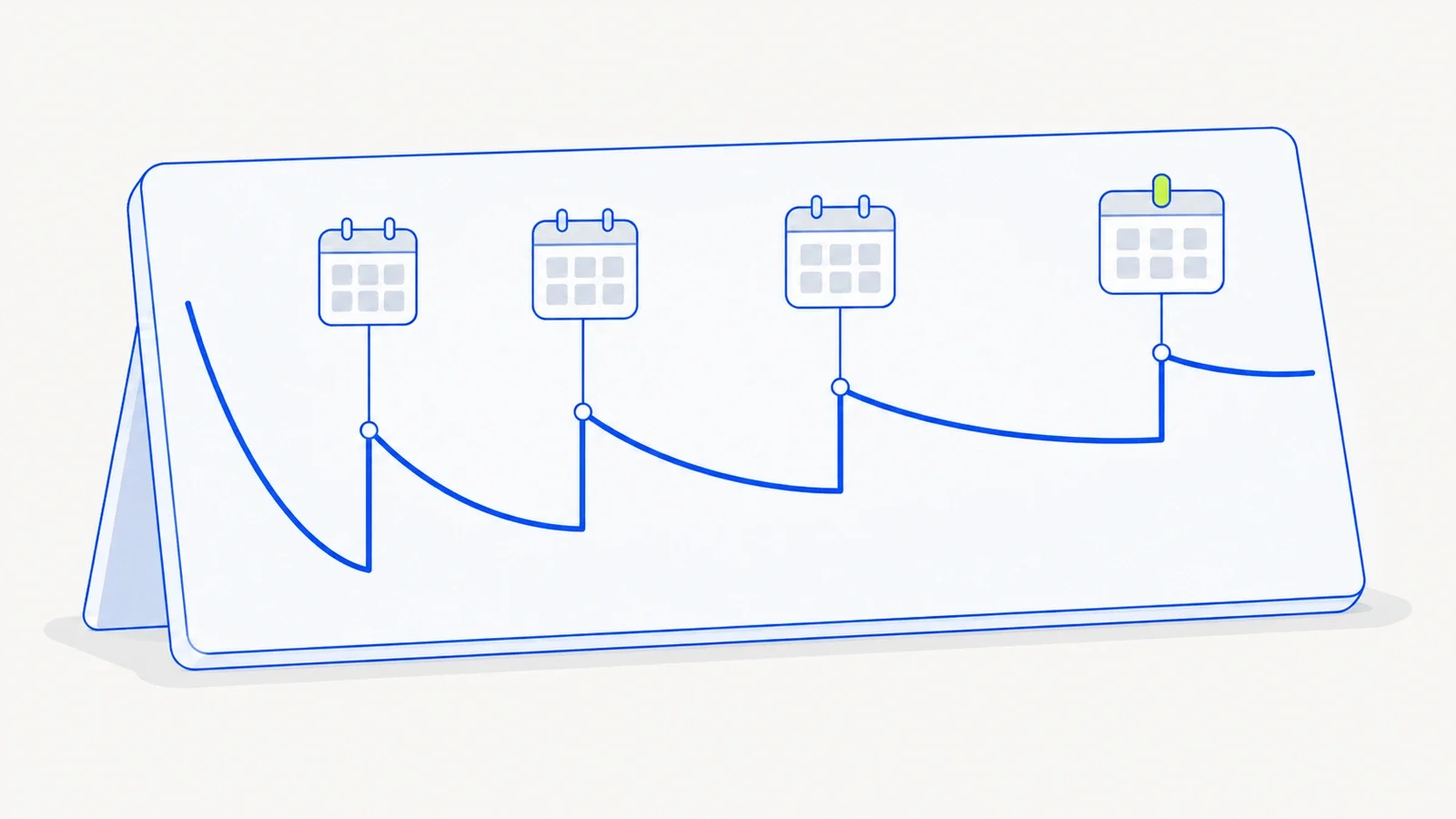
Things stick in memory when you come back to them several times with gaps in between. Most forgetting happens in the first days, so a short review the next day, then after three days, a week and two to three weeks, keeps far more than one long session.
Most of what you learn in a training session is gone within a few days, and that happens to everyone. The interesting question is how to slow it down, and the answer is one of the best supported findings in the psychology of learning: come back to the material several times, with gaps in between, instead of covering it once in depth.
This article explains how forgetting works, why spaced review beats a single long session, and how to plan your reviews with nothing more than a calendar.
How fast we forget
In the 1880s the German psychologist Hermann Ebbinghaus spent months memorizing lists of nonsense syllables and testing himself at different intervals to see how much he kept. The curve he drew from his results drops steeply in the first hours and days, then flattens out. Most of the loss happens early, and what survives the first week tends to last much longer.
Results that old deserve some suspicion, so in 2015 the Dutch researchers Jaap Murre and Joeri Dros repeated the experiment with the same method. Their subject spent about 70 hours learning lists and relearning them after delays from 20 minutes to 31 days. The curve came out very close to Ebbinghaus’s original. Their data also showed a small rise in retention around the 24-hour mark (PLOS ONE).
For anyone learning a work skill, the practical reading of the curve is simple. The first few days after a lesson decide most of what you keep, and a review in that window protects far more than a review a month later.
Why spreading your reviews out works
Suppose you have two hours to learn the main features of a new project management tool. You can spend both hours on Saturday, or you can spend forty minutes on Saturday, forty on Tuesday and forty the following week. The second plan wins clearly, and it is one of the most replicated results in learning research.
A large review by Nicholas Cepeda and colleagues brought together 317 experiments on this question and found the same pattern across them: spaced study beat massed study for later recall (PubMed). They also found that the ideal gap depends on how long you need to remember the material. A short gap suits something you need next week, and longer gaps suit something you want to keep for months.
There are a few reasons this works. Each review comes after some forgetting, so you have to rebuild part of the memory, and rebuilding strengthens it more than rereading something still fresh. Reviews on different days also link the material to more contexts, which makes it easier to bring back in a new situation. And spacing protects you from a trap that cramming sets: when everything is fresh, you overestimate how well you know it.
A review schedule you can follow
Software like Anki works out review dates for you, and it is worth using if you are learning a lot of separate facts, such as vocabulary or commands. For most work skills a paper or calendar schedule is enough. The version below follows the principle of widening gaps.
| Review | When | What to do |
|---|---|---|
| First | The day after you learn it | Recall the main ideas from memory, then check |
| Second | Three days later | Answer a few questions or solve one small problem |
| Third | One week later | Explain the topic in your own words |
| Fourth | Two to three weeks later | Use it on a real task, or teach it to someone |
If you miss a review, do it as soon as you can and carry on from there. The dates are a guide, and the two things worth keeping are the gap before each review and the habit of testing yourself during it.
Download the review planner
A one-page planner with this schedule and space for ten topics, ready to print.
Free. We will also send you our newsletter about new courses and guides. Unsubscribe in one click.
Making the reviews count
A review only helps as much as the effort it asks of you. Reading your notes again on day three adds little, because you will recognize everything on the page. The reviews that work make you produce something: a list of the key points written from memory, an answer to a question, a short explanation, a worked example. We go into the different ways of doing this in Testing Yourself Beats Rereading, and Here Is Why.
Keep each review short. Ten to fifteen minutes is usually enough, and short reviews are much easier to fit into a working week than long ones. A review that goes badly is useful too, since it shows you which topic needs the next session.
It also helps to mix topics within a review session instead of going through them one at a time. Switching between topics forces you to recall which idea applies where, which is closer to how you will use the skill at work.
Where spacing fits in a course
Spaced review works best alongside the other habits described in our guide on how to learn a new skill. Short lessons give you something manageable to review. Testing makes each review worth the time. Practice on real tasks shows you where the gaps are.
The free courses on Train Your Skills are split into short lessons with a test at the end of each one, which makes them easy to space out. A lesson every two or three days, with a quick look back at the previous one before you start, builds spacing into the course without any extra planning. You can browse the free courses and start with one skill.
Frequently asked questions
What is spaced repetition?
Spaced repetition means reviewing material several times with gaps between the reviews, usually making each gap longer than the last. It is based on the spacing effect, the finding that spread-out study leads to better long-term memory than the same amount of study in one block.
Do I need an app for spaced repetition?
No. Apps such as Anki are useful for large sets of separate facts, because they track hundreds of review dates for you. For learning a work skill with a handful of topics, a calendar or a printed planner does the job.
Is it bad to cram before a deadline?
Cramming can get you through a test the next morning, which explains why so many people still do it. Material learned in one block fades much faster afterwards than material learned over several sessions. If you need the skill after the deadline, spread the same hours out.
How many times do I need to review something?
There is no fixed number. The schedule in this article has four reviews, which is a reasonable start for a topic you want to keep for months. Topics you use regularly at work need fewer formal reviews, because the work keeps bringing them back, while topics you rarely use need the full set and sometimes a fifth.
Sources
- Murre, J. M. J., and Dros, J. (2015). Replication and Analysis of Ebbinghaus’ Forgetting Curve. PLOS ONE. ideas.repec.org
- Cepeda, N. J., Pashler, H., Vul, E., Wixted, J. T., and Rohrer, D. (2006). Distributed practice in verbal recall tasks: A review and quantitative synthesis. Psychological Bulletin. pubmed.ncbi.nlm.nih.gov