In short
An AI agent is software that uses an AI model to decide what to do toward a goal, takes actions with tools such as email, search or databases, and keeps going until the job is done. A chatbot answers; an agent acts.
“Agent” has become one of the most stretched words in technology. It is used for chatbots, for automations with an AI step, for coding assistants and for software that promises to run whole departments. When one word covers all of that, it becomes hard to judge what a product actually does, or whether you need one.
This article gives a working definition, explains how agents differ from chatbots and from automated workflows, and describes where they are useful at work today and where a simpler tool does the job better.
A working definition
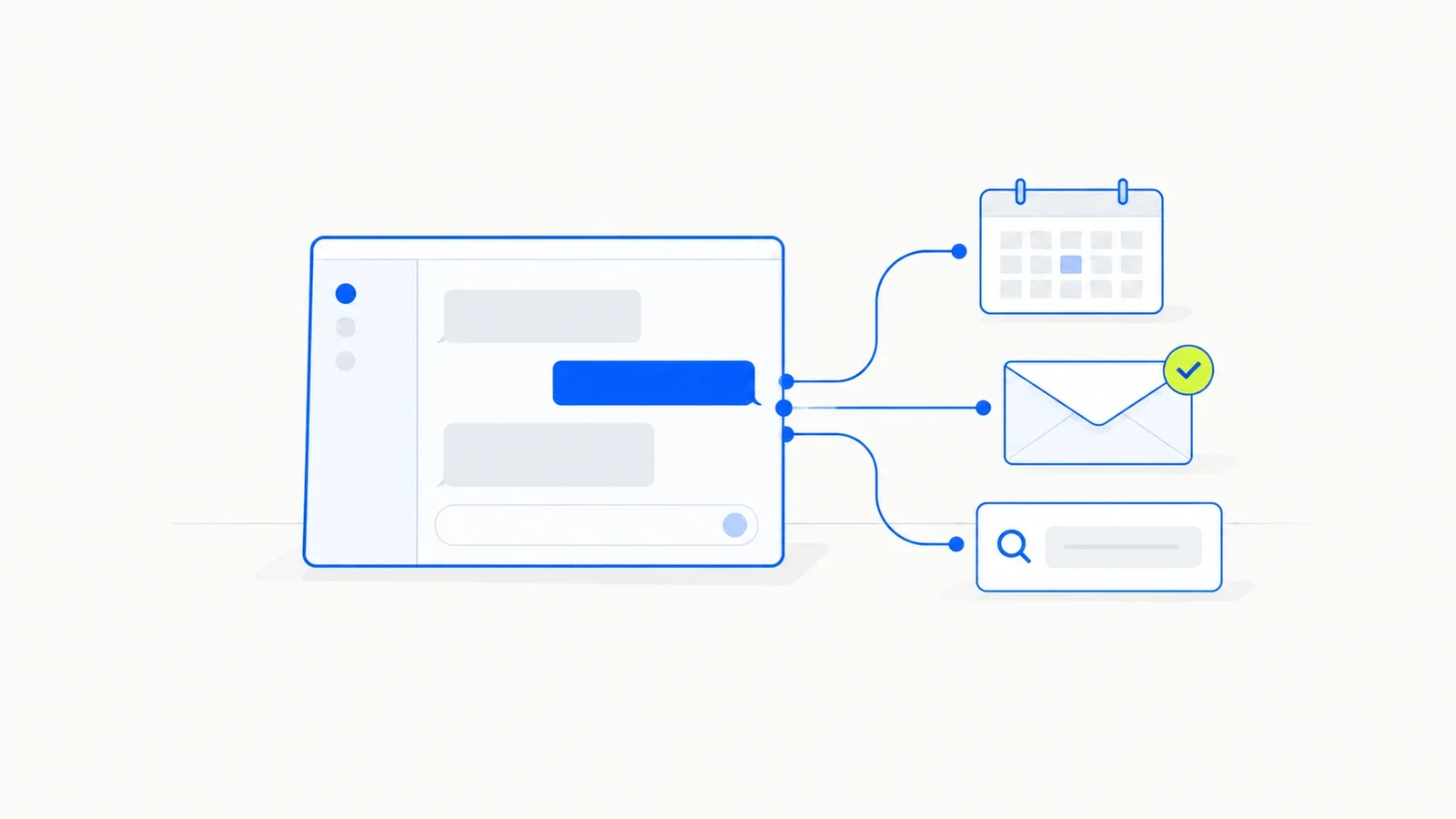
An AI agent is a system in which a language model decides what actions to take to reach a goal, uses tools to carry them out, looks at the results and decides what to do next, until it judges the goal is met.
Three parts make this work. The model does the reasoning: it reads the goal, plans and chooses actions. The tools let it act: searching the web, reading files, querying a database, sending an email, updating a record. The loop connects them: the model acts, observes what happened and decides again, instead of producing a single reply.
Anthropic, which builds the Claude models, describes agents as systems where models “dynamically direct their own processes and tool usage, maintaining control over how they accomplish tasks”, and contrasts them with workflows, where models and tools follow “predefined code paths” (Anthropic).
Agent, chatbot or workflow?
A chatbot answers you. It takes your message and replies with text, and if it is connected to a knowledge base it can answer questions about your documents. It does not go off and do things on its own.
An automated workflow follows steps someone designed. It may include AI steps, such as classifying an email or drafting a reply, but the sequence is fixed in advance: when this happens, do these steps in this order.
An agent decides the steps itself. Given “find three suppliers for recycled packaging in Spain with prices under our budget and draft a comparison”, it chooses what to search, which pages to read, when it has enough information and how to lay out the result.
In practice the lines blur. Most chat assistants can now search the web or run code, which gives them some agent behavior, and many automation platforms let you drop an agent into a workflow as one step. The question worth asking of any product is how much it decides on its own, and which tools it can use.
Examples of agents at work
Research. Gathering information from several sources, reading it and producing a summary or comparison. Deep research modes in ChatGPT, Claude and Gemini work this way.
Coding. Coding agents read a codebase, make changes across several files, run the tests and fix what fails, all from a description of the task.
Support triage. An agent reads a customer request, looks up the account, checks order status in another system, and either answers or passes the case to a person with the details already gathered.
Inbox and calendar work. Sorting messages, drafting replies, finding meeting times across calendars and preparing short briefings before meetings.
Data clean-up. Working through a list of records, checking each against other sources and flagging or correcting inconsistencies.
What these tasks share is that the number of steps cannot be known in advance, and that the agent needs to react to what it finds along the way.
When an agent is the wrong choice
The same guidance from Anthropic warns that the autonomy of agents brings “higher costs, and the potential for compounding errors”, and recommends using the simplest approach that works. Each decision an agent makes is a chance to go wrong, and a mistake early in a long chain affects every step after it.
An agent is usually the wrong tool when the steps are known and stable. If a task always runs the same way, a workflow with one or two AI steps will be cheaper, faster and easier to check. Agents also need care where mistakes are expensive, such as anything that sends messages to clients, changes financial records or deletes data. In those cases, keep a person approving the actions until the agent has proved reliable.
Download the agent or workflow card
Five questions that tell you whether a task needs an AI agent or a simpler workflow.
Free. We will also send you our newsletter about new courses and guides. Unsubscribe in one click.
How agents connect to your tools
An agent is only as useful as the tools it can reach. Connecting a model to each app used to mean writing custom code for every pairing. The Model Context Protocol, or MCP, is an open standard that lets an app expose its tools once and be used by any AI application that supports the protocol, which now includes ChatGPT, Gemini and Microsoft Copilot as well as Claude (Anthropic). We explain it in The Standard That Lets AI Use Your Tools.
Where this fits
Agents are one part of our guide to automating the work nobody wants to do. If you want to try building one, Your First Agent, Built in an Afternoon walks through a simple example in n8n. The free AI Agents course on Train Your Skills is coming soon, and the AI Automation with n8n course already covers adding AI to workflows. Start the course here.
Frequently asked questions
What is an AI agent in simple terms?
An AI agent is software that uses an AI model to decide what actions to take toward a goal, carries them out with tools such as search, email or databases, and keeps going until the job is done.
What is the difference between an AI agent and a chatbot?
A chatbot replies to your messages. An agent takes actions. A chatbot can tell you how to book a meeting; an agent can check calendars, find a time and send the invitation.
Are AI agents reliable enough for business use?
For well-defined tasks with good tools and a person checking important actions, many are. For long, open-ended tasks with no oversight, errors can build up. Start with low-risk tasks, review what the agent does, and widen its permissions gradually.
What are multi-agent systems?
Multi-agent systems split a task between several agents with different roles, such as one that researches, one that writes and one that reviews. They can handle larger tasks, but they are harder to build and debug, and they multiply cost. Most work tasks are better served by a single agent or a workflow.
Do I need to code to build an AI agent?
No. Platforms such as n8n, Zapier and Make let you build simple agents visually, and many AI assistants let you set up custom agents with instructions and connected tools. Code gives more control for complex agents.
Sources
- Anthropic, “Building effective agents”. anthropic.com
- Anthropic, “Donating the Model Context Protocol and establishing the Agentic AI Foundation”. anthropic.com